









On November 4, 2025, Meredith Roberts woke up thinking about school, swim practice, band rehearsals, and college plans.
The 17-year-old high school senior of Buffalo, New York, was thriving. An honors student and nationally-ranked competitive swimmer, Meredith spent her days balancing advanced classes, swim meets, and playing the alto saxophone. Her future was full of possibility. Then, in a matter of hours, everything changed.
A Sudden Medical Emergency
What began as a subtle yellowing of Meredith’s eyes quickly escalated into a life-threatening emergency. After routine blood work revealed critically elevated bilirubin levels, Meredith’s family rushed her to a local hospital. Initial testing ruled out common causes, but as her condition rapidly deteriorated, doctors delivered devastating news: she might need a liver transplant. Just 12 hours earlier, Meredith had been swimming laps at practice. Now, she was facing acute liver failure.
As toxins built up in her body, Meredith became increasingly confused and eventually lost awareness of what was happening around her. She was transferred by ambulance to UPMC Children’s Hospital of Pittsburgh, which was four hours away from her home, where one of the most experienced pediatric liver transplant teams in the world immediately began life-saving treatment.
"One day I was worried about homework and swim practice," says Meredith. "The next day, my entire world had changed."
Racing Against Time
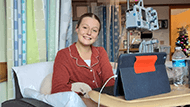
In the Pediatric Intensive Care Unit (PICU), specialists worked around the clock to stabilize Meredith. She underwent daily plasmapheresis treatments, a medical procedure that removes harmful antibodies, toxins, or inflammatory proteins from the blood, and received more than 160 units of blood products as her medical team fought to keep her alive.
Meanwhile, family, friends, and strangers rallied around her. After Meredith’s story was shared publicly, more than 600 people stepped forward to volunteer as potential living-liver donors.
The support was overwhelming, but Meredith’s condition was worsening quickly, so waiting for a living-liver donor was not an option. On November 9, she was listed as Status 1A, the highest priority on the transplant waiting list for patients with acute liver failure. Without a transplant, she likely had less than a week to live.
"It was impossible not to think about what a donor liver meant," says Meredith’s mother, Sara. "We were praying for our daughter to live while knowing another family would be facing unimaginable loss."
The Call That Changed Everything
Just days later, the family received the news they had been desperately hoping for: a deceased-donor liver had become available. Meredith’s transplant team moved quickly, and on November 15, 2025, she received the liver transplant that saved her life.
Her diagnosis was later identified as Wilson’s disease, a rare, inherited disorder that prevents the body from properly processing copper, causing it to dangerously accumulate in the liver, brain, and eyes. For Meredith and her family, the gift of organ donation transformed tragedy into hope.
"Your loved one became the reason I am standing here today," Meredith said in a message to her donor family. "Because of your courage, your compassion, and your willingness to think of others during a moment filled with grief, I was given a second chance."
Meredith credits her care team at UPMC Children’s for helping her navigate some of the most difficult days of her life.
"They fought for me when I couldn't fight for myself," says Meredith. "They cared for me with a level of devotion that goes far beyond medicine. They supported my family, answered every question, calmed every fear, and stood by us with unwavering strength. Their hands, their hearts, and their expertise carried me through the most fragile moments of my life, and I will never forget what they did for me.”
Life Posttransplant
Less than a year after her transplant, Meredith has already reclaimed the life that nearly slipped away. She returned to school, resumed swimming, and rejoined the school band. She earned her lifeguard certification and spent her summer teaching swimming lessons. She celebrated milestones that once felt uncertain, including graduating high school with her classmates and moving into college at Fairfield University, where she is part of the women’s swimming team. Most importantly, she was able to dream about the future again.
"Every early morning, every ordinary moment, I get to grow up,” says Meredith. “I get to dream and I get to live.”
Honoring a Hero
Today, Meredith carries deep gratitude for the donor and donor family who made her second chance possible.
"To my donor family, I carry your loved one with me every single day," says Meredith. "I promise to live a life worthy of the gift you shared. I promise to honor their memory with kindness, purpose, joy, and the determination to make the most of every moment I've been given."
“Meredith’s story is such an amazing encouragement to all of us on the transplant team; she so vividly reminds us of how transplant ultimately is about letting young people be the amazing people they were meant to be,” says George Mazariegos, MD, chief of pediatric transplantation at UPMC Children’s.
Meredith’s treatment and results may not be representative of all similar cases.